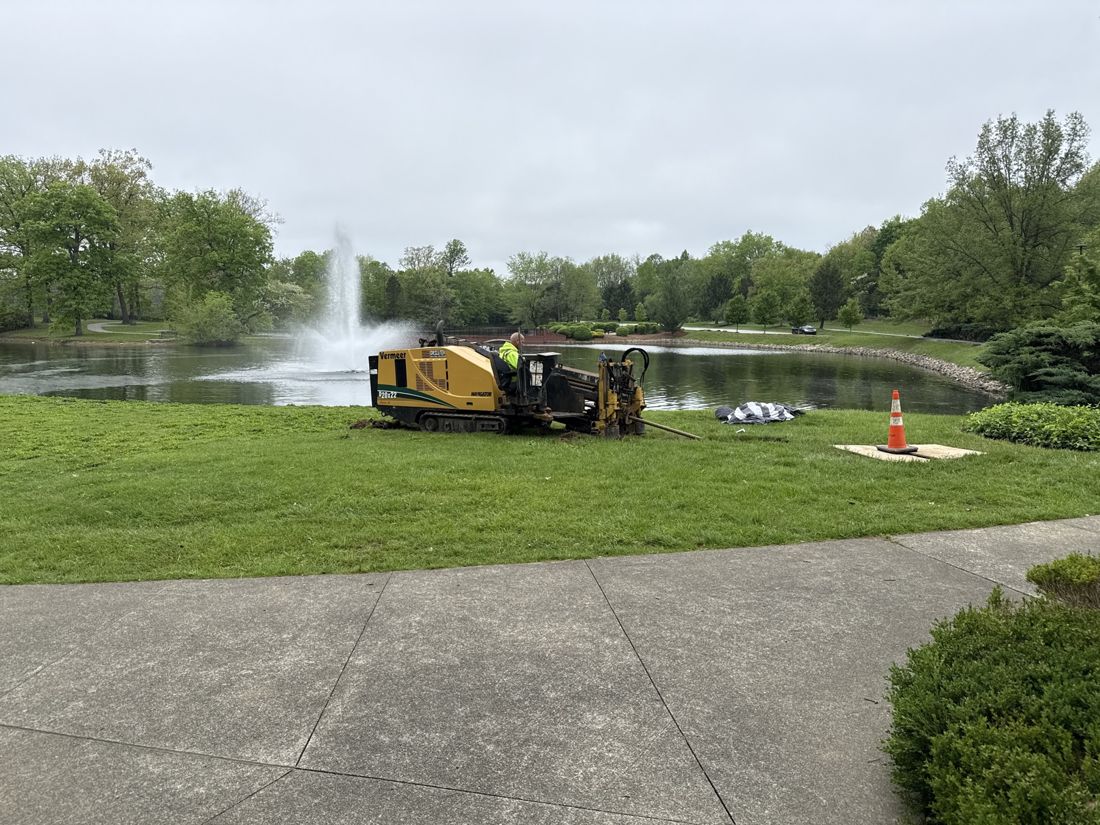
A creek, a river, or a wetland sits between where a utility starts and where it needs to go. You can't dig a trench across running water without tearing up the bed and the banks, and in most places you won't get the permit to try. So the line goes underneath, deep below the streambed, in one continuous run. Here's how that crossing actually gets made.
Why You Don't Trench a Waterway
Open-cutting across a stream means diverting or damming the flow, excavating through the bed, and disturbing both banks. That stirs up sediment, damages habitat, and leaves scars that take seasons to recover. Regulators know this, which is why a trench through a live waterway rarely clears review. Even a small creek usually falls under protections that make an open cut the wrong tool.
Horizontal directional drilling, HDD, solves it by never touching the surface of the water at all. The line passes far beneath the bed, the banks stay intact, and the flow keeps moving the whole time the work is underway.
How the Crossing Is Drilled
A river crossing is a designed path, not a straight shot. The rig sets up on one bank, and a steered pilot bore starts at a shallow angle, drives down beneath the streambed, runs level well below it, and climbs back to the surface on the far bank. A locating system tracks the drill head the entire way, so the crew knows its depth and position at every point.
Once the pilot bore is complete, the path is reamed out to the diameter the utility needs, and the product line is pulled back through in a single continuous length. The finished crossing has no joints under the water and two modest work areas, one on each bank, instead of a channel cut through the middle.
Depth and Cover Below the Bed
The number that matters most on a river crossing is cover, how much ground sits between the top of the installed line and the bottom of the streambed. Enough cover keeps the utility clear of scour, the way a current digs into and lowers a channel bottom over time, especially during high water. A crossing set too shallow can be exposed by a single big storm. Depth is planned around the specific waterway, its banks, and how the channel is likely to move, so the line stays protected for the long haul.
Entry and Exit Placement
Where the bore enters and exits decides most of the rest. The pits sit back from the banks on stable ground, clear of the floodway where practical, with room for the rig, the pulling side, and the pipe to be staged and welded before pullback. Good placement keeps the whole operation out of the sensitive zone right at the water's edge and inside the ground you're actually allowed to work.
Staying Inside the Permitted Corridor
A water crossing almost always comes with a permitted corridor, a defined strip you're cleared to work and drill within, tied to environmental and right-of-way approvals. The bore path has to live inside it from entry to exit. That's where locating and planning earn their keep: before anything turns, existing utilities are located, the alignment is set, and the design is checked against the corridor so the drill head never wanders outside the approved footprint. Permitting a waterway takes lead time, and building it into the schedule up front keeps the job from stalling later.
Environmental Care During the Bore
The drilling fluid that carries cuttings out and stabilizes the hole has to stay in the hole. The risk to watch for is an inadvertent return, sometimes called a frac-out, fluid finding a path up through the ground and surfacing where it shouldn't, including into the waterway. Keeping that from happening is a core part of doing a crossing right:
- Sound depth and cover so the bore stays in competent ground and away from weak paths to the surface.
- Controlled fluid pressure matched to the ground, rather than forcing the hole open.
- Monitoring during the bore so any change in returns is caught early, not after fluid reaches the water.
- Containment and a response plan ready at the banks before the work starts.
The drilling fluid used for these crossings is typically a bentonite clay slurry, but the goal is the same regardless: keep it contained, keep it circulating, and leave the waterway exactly as clean as you found it.
What Crosses This Way
Most buried utilities can be carried under a waterway with a directional bore. The common ones:
- Fiber and telecom conduit connecting networks across a river or floodplain.
- Water and sewer force mains tying systems together across a creek.
- Gas lines that need protected, continuous crossings with no joints under the water.
- Electric duct banks routing power beneath a stream instead of over it.
Whatever the product, the pattern holds: locate first, plan the path and the depth, permit the corridor, and drill a clean crossing that leaves the water untouched.
How DrillTek Approaches a Crossing
We start with the site, not the rig. We look at the waterway, the banks, the ground below the bed, and the corridor you're cleared to work in, then design a path with the depth and cover the crossing needs. Locating comes before drilling, containment is in place before fluid moves, and the bore is monitored the whole way across. The result is a line safely under the water and a streambed that looks like nobody was ever there.