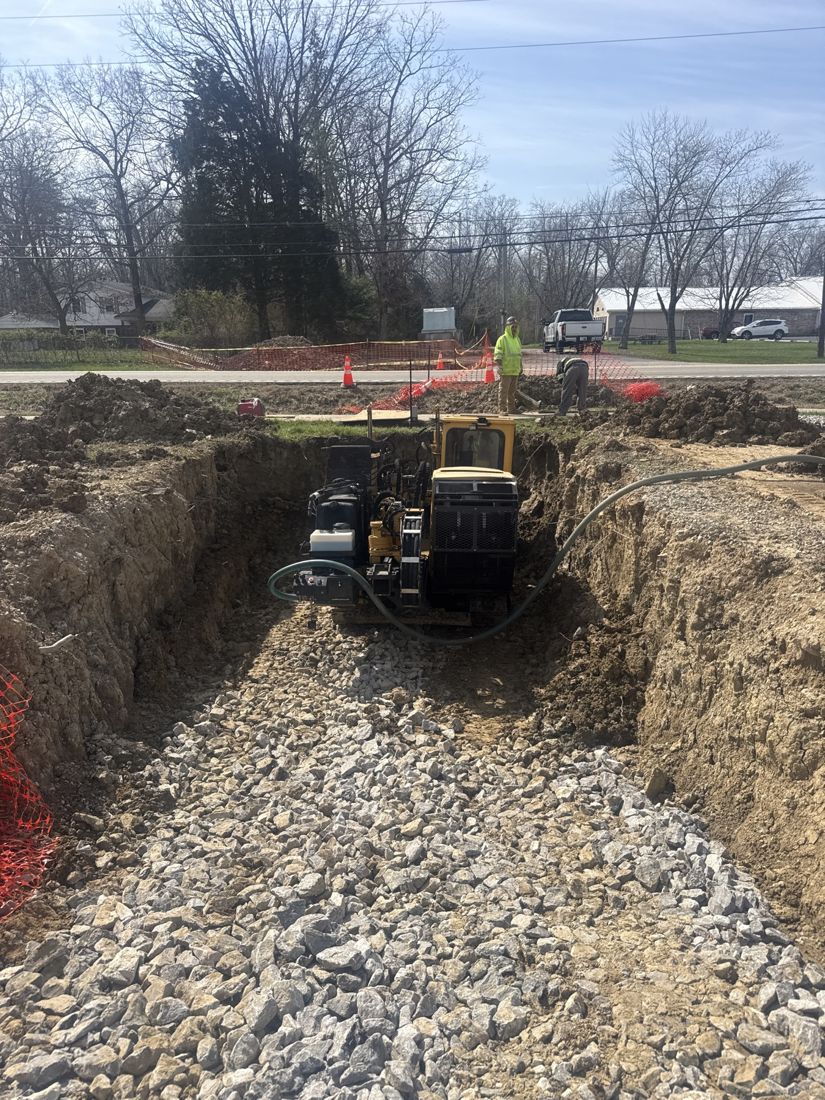
Two ways to put a utility in the ground: bore it in without opening the surface, or trench a channel, lay the line, and backfill. Both are the right answer somewhere. Picking the wrong one costs money and time, so here's how the choice actually gets made.
What Each Method Is
Open-cut trenching is the direct approach. A machine digs a continuous channel along the utility route, the pipe or conduit is laid in the bottom, and the trench is backfilled and compacted. You have full access to the line the entire way, which makes it simple to inspect, bed, and grade.
Directional boring, horizontal directional drilling, or HDD, is trenchless. Instead of a long open channel, a rig drills a small steered pilot bore along a designed path, reams it out to the diameter you need, and pulls the product line back through in one continuous run. The utility goes in underground with two small pits at the ends instead of a scar down the whole route.
The Decision Framework
The choice usually comes down to what's on the surface above the line and how far you have to go. A few clear patterns hold up on almost every job.
When Trenching Wins
- Open, undeveloped ground. If the route runs across a bare field or a graded lot with nothing above it, the surface disruption of a trench costs almost nothing to restore. Trenching is often the cheaper install per foot in that case.
- Shallow, short runs. For a short line at modest depth, setting up a bore can cost more than simply digging it.
- Precise grade requirements. Gravity sewer and storm lines need a controlled slope. An open trench lets a crew set and verify grade directly, which is harder to guarantee on a bore.
- Multiple lines in one corridor. If several utilities share a route at the same depth, one open trench can carry them all.
When Directional Boring Wins
- Crossings. Roads, driveways, railways, and parking lots are the classic case. Boring underneath avoids cutting and repaving pavement, and often avoids the permits, lane closures, and traffic control an open cut would trigger.
- Water crossings. Under a creek, river, or wetland, a bore installs the line well below the bed without disturbing the banks or the flow.
- Finished surfaces. Mature landscaping, hardscape, established lawns, and paved lots are expensive to tear up and restore. A bore protects them.
- Congested corridors. Where existing utilities crowd the route, a steered, tracked bore path threads new line past them with controlled separation.
Cost Factors That Actually Move the Number
Comparing the two on install price per foot alone is misleading, because the real cost of trenching lives in what happens after the line is in. Weigh the whole picture:
- Surface restoration. Repaving, concrete replacement, landscaping, and re-grading can dwarf the digging itself. This is where boring recovers its higher setup cost.
- Traffic control and permits. Cutting a road brings lane closures, flaggers, and permit conditions that a bore underneath can sidestep.
- Depth and length. Deeper and longer runs raise trench shoring and spoil-handling costs, while a bore may take them in stride.
- Soil and rock. Ground conditions cut both ways, cobble and rock slow a bore, while unstable or wet soil complicates an open trench.
- Downtime. A crossing that would close a lane or a driveway for days can often be bored in a fraction of the time.
Surface Restoration
This is the difference people underestimate. An open trench has to be backfilled in lifts, compacted, and brought back to grade, and any pavement, curb, or landscaping on top has to be rebuilt to match. On a finished site, restoration can take longer and cost more than the excavation. A bore leaves two small pits to close and little else, which is why it so often wins on total cost even when its per-foot install price looks higher.
How DrillTek Decides
We don't lead with a method, we lead with the site. We look at what's above the route, the ground below it, the length and depth of the run, the grade the line needs, and what restoration would cost either way. On plenty of jobs the honest answer is a trench, and we'll tell you so. On crossings, water, and finished ground, a bore usually comes out ahead. Often the best plan is both: trench the open stretches and bore the crossings. Either way, nothing turns until the utilities are located and the path is clear.